
Your Skin Eats Too!
If you read food labels… why not skincare labels?
You already ask questions about what goes into your body.
Protein or processed?
Artificial or real?
Ingredients you recognize—or ingredients you can’t pronounce?
But when it comes to skincare?
Most of us trust the front of the bottle.
“Natural.”
“Derm tested.”
“Anti-aging.”
“Clean.”
Meanwhile the ingredient list on the back feels impossible to decode.
And yet your skin is your body’s largest organ.
It protects you every minute of every day.
So maybe skincare shouldn’t begin with trends.
Maybe it begins with a better question:
What am I asking my skin to do every single day?

The Problem: More Products. More Promises. More Confusion.
Walk into any beauty aisle and you’ll find thousands of products promising glow, repair, anti-aging, brightening, lifting, tightening and overnight results.
Consumers increasingly use ingredient-checking apps and databases because choosing skincare has become overwhelming—not because every ingredient is dangerous, but because people want transparency and help understanding formulations.
At the same time, dermatology and skincare science have shifted toward something interesting:
Not stripping skin.
Not fighting skin.
Supporting skin.
One growing area of focus is the skin microbiome—the community of microorganisms that live naturally on skin and help support barrier function and skin health. Disruption of this balance has been associated with dryness, irritation and other skin concerns.

The Question That Changed How I Thought About Skincare
I have the thank my friend Corrine, she had a beautiful Tree house in the jungles of Costa Rica, I remember being asked to avoid certain soaps and cleansers.
Not because they were “toxic.”
Because the ecosystem mattered.
Greywater systems and sensitive environments can be affected by detergents and cleansing agents.
I remember thinking—
If ingredients matter enough to think about where they go…
should I also think about how they interact with my skin?
That moment stayed with me.
What should you look for?
Not fear.
Not marketing.
Look for:
✓ Ingredient transparency
✓ Products designed to support the skin barrier
✓ Formulations appropriate for your skin type
✓ Evidence of testing when claims are made
✓ Routines simple enough to maintain
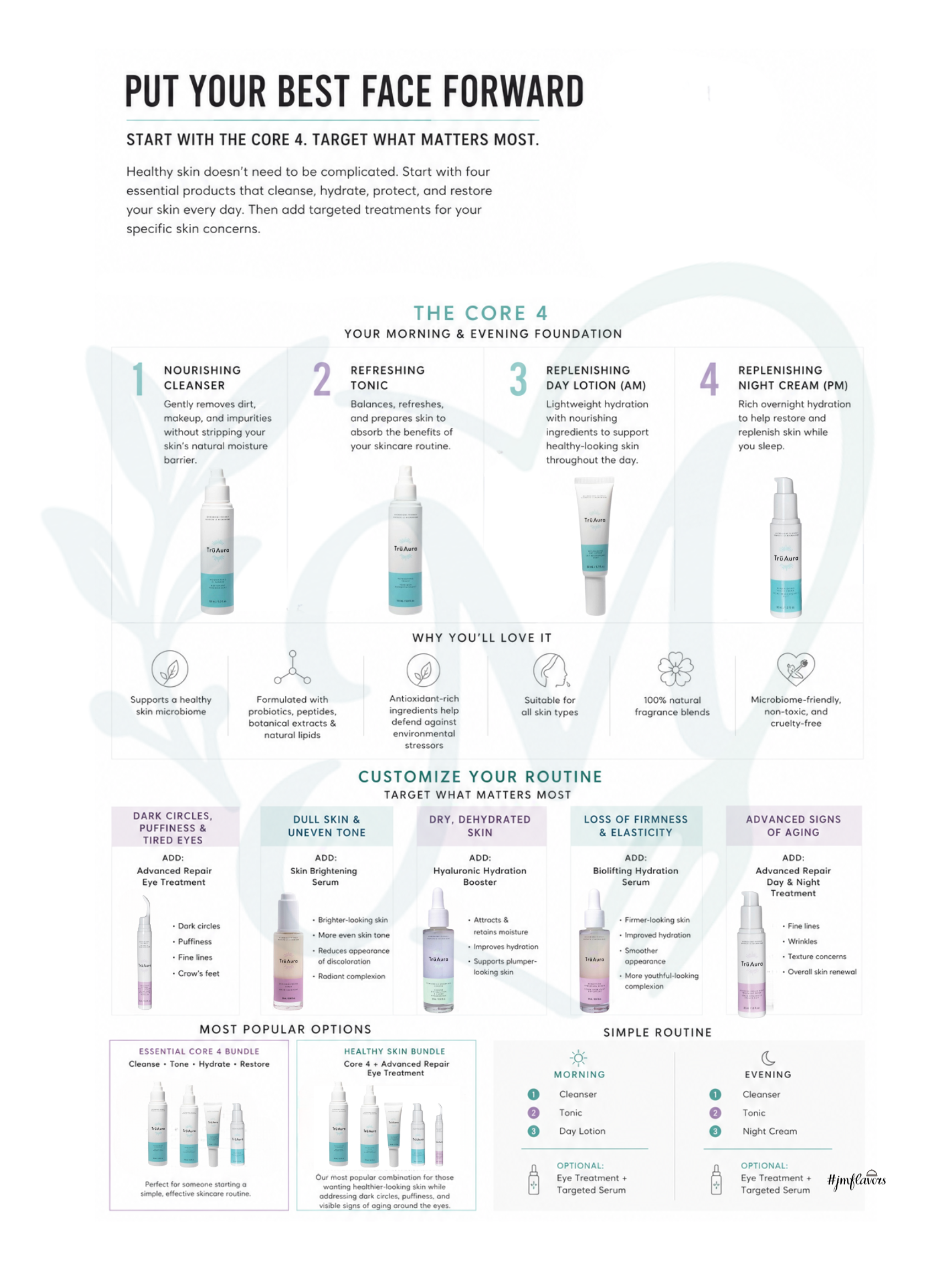
Why I Chose TruAura®
TruAura positions itself as a microbiome-friendly skincare line designed to support the skin’s natural barrier rather than aggressively stripping or overloading it. According to the company, formulations include prebiotic and probiotic-inspired ingredients and exclude more than 6,900 ingredients they identify as inconsistent with their formulation philosophy.
Their published “No List” includes avoiding categories such as:
synthetic fragrance
parabens
phthalates
sulfates (including SLS/SLES)
certain preservatives and other ingredient classes
The company also reports independent testing supporting microbiome-friendly claims and preservation of microbiome diversity over an 8-week study period. Those claims come from TruAura’s own published materials and I cannot independently verify the study quality beyond what they disclose publicly.
That distinction matters.
Because good skincare isn’t about eliminating every “bad” ingredient.
It’s about choosing products that fit your skin and support long-term skin health.
A SKIN ROUTINE
General education—not medical advice)
One final though
You don’t need 14 products.
You don’t need to memorize chemistry.
You just need to become curious enough to ask:
Would I put this level of thought into my food… and if not, why not my skin?